When an engine seizes or a transmission fails, the root cause often traces back to a defect that existed before the parts were ever assembled. These failures damage reputations, lead to expensive recalls, and create safety hazards. Automotive manufacturers have turned to eddy current inspection as a primary method for catching these defects early in the production process.
What Eddy Current Inspection Does
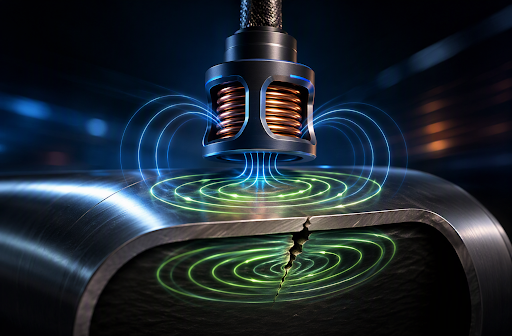
Eddy current inspection is a nondestructive testing method that uses electromagnetic fields to find surface and subsurface defects in conductive materials. An alternating current passes through a coil and thus a magnetic field is created. When this field interacts with a metal part, it generates eddy currents in the material. Any disruption in those currents, caused by a crack, a material mix-up or a hardness variation, triggers a measurable change that the system detects. This happens in milliseconds and the part remains completely undamaged.
Finding Defects Before Assembly
Engine and transmission components face enormous stresses during operation. A crack in a connecting rod, a gear tooth or a valve spring can cause catastrophic failure. Eddy current inspection excels at finding these discontinuities. The technology detects critical surface cracks and subsurface cracks that might compromise part integrity. In many automotive applications, eddy current systems can identify cracks as small as 0.1 mm in depth. Parts with these defects are automatically rejected, keeping them out of assembled engines and transmissions.
Heat treatment is another area where problems frequently develop. Improper heat treatment can leave a part too soft or too brittle. The General Motors recall of over 26,000 cars in 2011 happened because rear axle cross pins were never heat-treated at all. Without proper hardness, these pins could displace or fracture, causing the rear axle to malfunction. Eddy current testing validates whether a material has been properly hardened without needing to destroy parts for sample testing. It can also confirm the correct alloy composition.
Material mix-ups pose another risk. A batch of fasteners made from the wrong steel grade could fail under load but eddy current systems can distinguish between various material compositions and avoid these mix-ups. This is valuable for suppliers who produce parts for multiple customers using different material specifications.
Maintaining Standards and Reducing Recalls
Automakers require their suppliers to meet strict OEM specifications and eddy current inspection helps manufacturers maintain those standards by providing objective pass or fail decisions. Each part produces a magnetic signature, acceptable limits can be defined and any deviation triggers rejection. This removes the subjectivity of manual methods like magnetic particle or dye penetrant testing where results are dependent upon on the interpretation of the operator.
The cost of missing a defect is high. Even a 1% scrap or rework rate can damage margins and allowing a defective part to reach an assembly line can trigger a recall costing millions. High-speed eddy current systems can inspect 100% of production without slowing throughput, catching the defective parts before they become a problem.
How Mectron Handles This
Mectron’s inspection systems incorporate eddy current technology along with other methods to provide comprehensive component testing. The Q-5000 system, for instance, combines a 360-degree laser scan with digital eddy current inspection. The eddy current component provides metallurgical inspection, detecting cracks, material variations and hardness issues. The lasers handle dimensional checks for thread defects, bends and other geometric issues. The system operates at high speed, automatically discarding any part that fails inspection.
Mectron’s Magnetic Imagery™ technique generates a magnetic image of each part as it passes through the inspection coil. This full signature reveals cracks, mixed materials, conductive plating issues and hardness variations by visual deviations in the magnetic image. Operators can define acceptable limits using touch-screen programming, making setup straightforward.
The Bottom Line
Eddy current inspection serves as a gatekeeper for engine and transmission component quality, catching cracks, material mix-ups and heat treatment problems before assembly. Manufacturers avoid the cost and reputation damage of field failures while suppliers and automakers alike gain the detection capability needed to deliver reliable and safe vehicles. Contact us today to get started.